845, Ground Floor, Udyog Vihar Phase V, Sector 19, Gurugram, Haryana 122016
GET DIRECTION
Amethyst vs Purple Sapphire: Key Differences
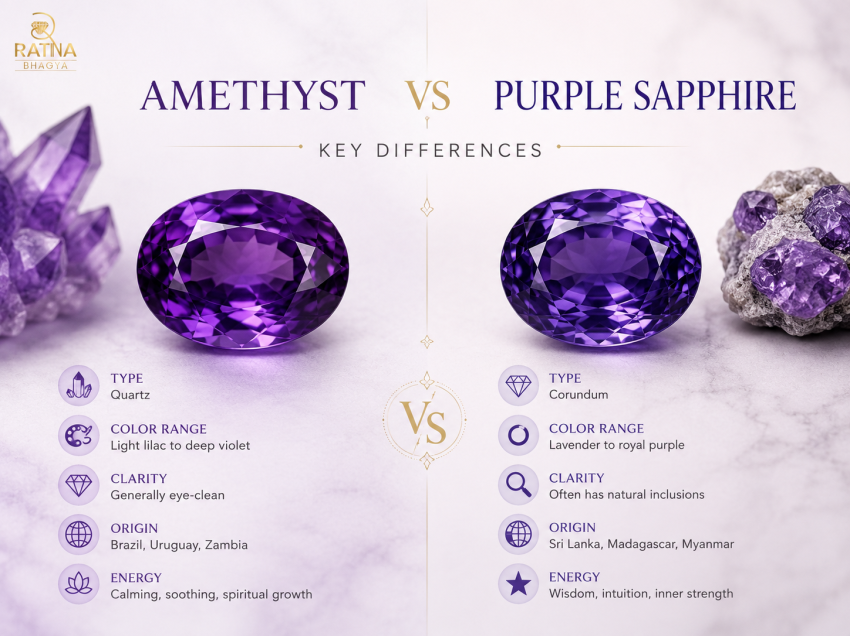
Purple gemstones have fascinated jewelry lovers for centuries, and two of the most popular choices are Amethyst and Purple Sapphire. At first glance, these gemstones may appear similar because of their beautiful violet hues, but they differ significantly in terms of composition, durability, rarity, value, and overall appeal.
Whether you're buying a gemstone for jewelry, collecting, or simply learning more about gemstones, understanding the differences between Amethyst and Purple Sapphire will help you make an informed decision.
In this guide, we'll compare these two stunning gemstones across several important factors.
What Is Amethyst?
Amethyst is the purple variety of quartz, one of the most abundant minerals on Earth. Its attractive color comes from trace amounts of iron and natural irradiation during its formation.
Amethyst has been prized for thousands of years and is widely used in rings, pendants, bracelets, earrings, and decorative objects.
Major sources include:
- Brazil
- Uruguay
- Zambia
- Madagascar
- Russia
What Is Purple Sapphire?
Purple Sapphire is a rare variety of corundum, the same mineral family as Ruby and Blue Sapphire.
Its purple color results from trace elements such as iron and titanium, sometimes combined with other natural factors during crystal formation.
Purple Sapphire is less common than blue sapphire and is highly valued for its brilliance and durability.
Major sources include:
- Sri Lanka
- Madagascar
- Myanmar
- Tanzania
- Australia
Amethyst vs Purple Sapphire: Quick Comparison
| Feature | Amethyst | Purple Sapphire |
|---|---|---|
| Mineral Family | Quartz | Corundum |
| Color | Light lavender to deep purple | Violet, purple, bluish-purple |
| Mohs Hardness | 7 | 9 |
| Durability | Good | Excellent |
| Rarity | Common | Relatively rare |
| Price | More affordable | Generally more expensive |
| Transparency | Transparent to translucent | Usually transparent |
| Everyday Wear | Suitable with care | Excellent for daily wear |
Color Comparison
Amethyst
Amethyst is available in shades ranging from:
- Pale lavender
- Lilac
- Medium violet
- Deep royal purple
High-quality amethyst often displays rich purple color with flashes of red or blue.
Purple Sapphire
Purple Sapphire typically exhibits:
- Rich violet
- Bluish-purple
- Pinkish-purple
- Deep royal purple
Its color often appears more vivid and saturated than Amethyst.
Hardness and Durability
One of the biggest differences is durability.
Amethyst
- Mohs Hardness: 7
- Suitable for everyday jewelry with reasonable care.
- Can scratch more easily than sapphires.
Purple Sapphire
- Mohs Hardness: 9
- One of the hardest gemstones after diamond.
- Highly resistant to scratches.
- Excellent for engagement rings and daily wear.
If durability is your priority, Purple Sapphire has a clear advantage.
Brilliance and Sparkle
Amethyst
Amethyst has a soft, elegant glow with vitreous luster.
Its sparkle depends largely on the quality of the cut.
Purple Sapphire
Purple Sapphire generally exhibits:
- Greater brilliance
- Better light reflection
- Stronger sparkle
Its higher refractive index gives it a brighter appearance.
Rarity
Amethyst
Amethyst is widely available worldwide.
Large, beautiful stones are relatively easy to find.
Purple Sapphire
Purple Sapphire is significantly rarer.
Fine-quality stones with vivid color are much less common, making them more desirable among collectors.
Price Comparison
Price differences can be substantial.
Amethyst
Generally offers:
- Excellent affordability
- Great value for larger stones
- Ideal choice for budget-conscious buyers
Purple Sapphire
Typically costs more because of:
- Greater rarity
- Higher durability
- Increased demand
- Premium gemstone status
Clarity
Amethyst
Many amethysts are eye-clean, though natural inclusions may occur.
Purple Sapphire
Natural inclusions are common, but high-quality stones often have excellent transparency and brilliance.
Professional certification helps verify authenticity and treatments.
Treatments
Amethyst
Most natural amethysts receive little or no treatment.
Some lower-quality quartz may be dyed to imitate amethyst.
Purple Sapphire
Heat treatment is commonly used to improve color and clarity.
Reputable sellers should disclose any treatments.
Jewelry Applications
Amethyst
Commonly used in:
- Rings
- Earrings
- Pendants
- Bracelets
- Fashion jewelry
Its affordability makes it popular for large statement pieces.
Purple Sapphire
Frequently chosen for:
- Engagement rings
- Luxury jewelry
- Wedding bands
- Investment-quality pieces
Its durability makes it ideal for jewelry worn every day.
Astrological Significance
Amethyst
In various spiritual traditions, Amethyst is often associated with:
- Calmness
- Meditation
- Mental clarity
- Inner peace
These associations are symbolic and cultural rather than scientifically established.
Purple Sapphire
Unlike Blue Sapphire, Purple Sapphire has no universally recognized role in traditional Vedic astrology.
Its use is generally based on personal preference rather than standard astrological recommendations.
How to Choose Between Amethyst and Purple Sapphire
Choose Amethyst If:
- You're looking for an affordable purple gemstone.
- You enjoy soft, elegant purple tones.
- You want larger gemstones within your budget.
- You're buying fashion jewelry.
Choose Purple Sapphire If:
- You want superior durability.
- You're purchasing an engagement ring.
- You appreciate rare gemstones.
- You're seeking a premium investment-quality stone.
How to Identify Genuine Stones
Genuine Amethyst
Look for:
- Natural color zoning
- Rich purple hues
- Minor natural inclusions
- Certification for valuable purchases
Genuine Purple Sapphire
Look for:
- Strong brilliance
- Rich, even color
- Excellent transparency
- Certification from a recognized gemological laboratory
Frequently Asked Questions (FAQs)
Is Purple Sapphire more expensive than Amethyst?
Yes. Purple Sapphire is generally more expensive because it is rarer, more durable, and belongs to the precious corundum family.
Which gemstone is harder?
Purple Sapphire is significantly harder, with a Mohs hardness of 9, compared to 7 for Amethyst.
Can you wear Amethyst every day?
Yes, but it requires more care than Purple Sapphire because it is softer and more susceptible to scratches.
Do Amethyst and Purple Sapphire look alike?
They can appear similar in color, but Purple Sapphire generally has greater brilliance, durability, and a richer appearance.
Which gemstone is better for engagement rings?
Purple Sapphire is usually the better choice because of its exceptional hardness and durability.
Conclusion
Amethyst and Purple Sapphire are both beautiful purple gemstones, but they cater to different preferences and budgets. Amethyst offers affordability, attractive color, and timeless elegance, making it an excellent choice for everyday jewelry and first-time gemstone buyers.
Purple Sapphire, on the other hand, stands out for its rarity, remarkable durability, and brilliant sparkle. Its premium quality makes it ideal for fine jewelry, engagement rings, and long-term investment.
By understanding the differences in composition, hardness, rarity, price, and appearance, you can confidently choose the gemstone that best matches your style, lifestyle, and budget.
Share this post:
You Might Also Be Interested In
Discover more insightful articles related to this topic to deepen your gemstone knowledge.
13 April
Different Colour Varieties of Sapphire Jewellery
Sapphires are regarded as one of the most valuable gemstones on the planet. Since their...
27 May
RatnaBhagya, brings you to the world of Blue Sapphire (Neelam)
Blue Sapphire is related to the planet Saturn. It is a well-known blue valuable gemstone....
22 April
Are you worried about your marriage? Your difficulty will be solved by Yellow Sapphire
The yellow sapphire stone (Pukhraj) is one of the most powerful jewels. It is regarded...
17 June
How to Check If a Red Coral Stone Is Real or Fake
Red Coral (Moonga) is one of the most popular gemstones in Vedic astrology, valued for...
9 March
10 Most Valuable Gemstones in The World
Each Valuable gemstones are novel in its own specific manner. However, which of the numerous...
31 March
FREQUENTLY ASKED QUESTIONS ABOUT PEARL (MOTI)
What is the meaning of pearl? Like Coral and Amber, Pearl (also called Moti in...