845, Ground Floor, Udyog Vihar Phase V, Sector 19, Gurugram, Haryana 122016
GET DIRECTION
Red Coral Gemstone Price Guide: Natural vs Treated Coral
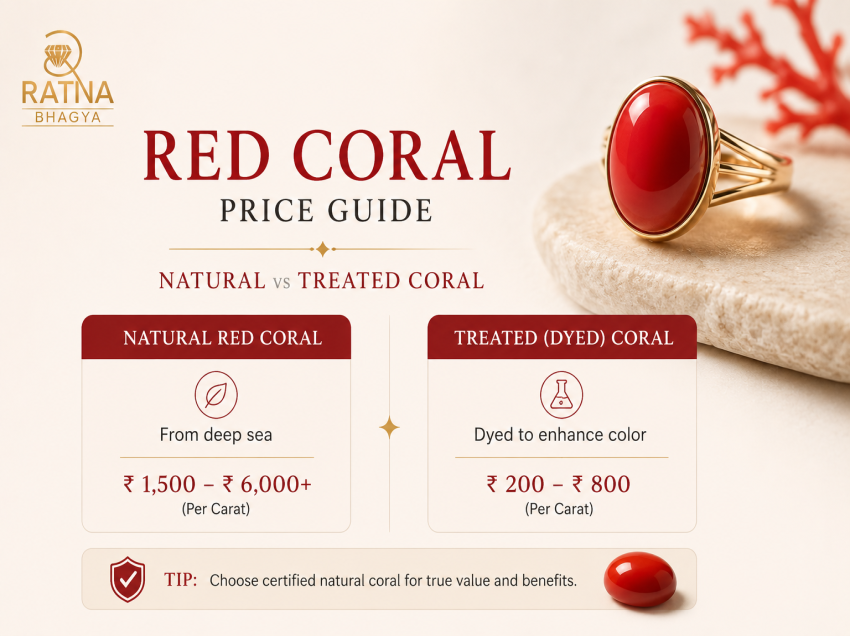
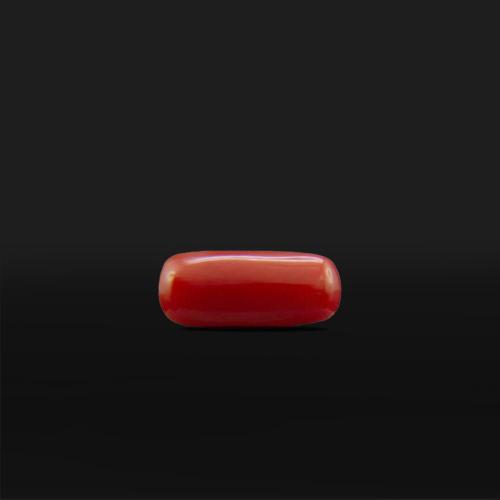
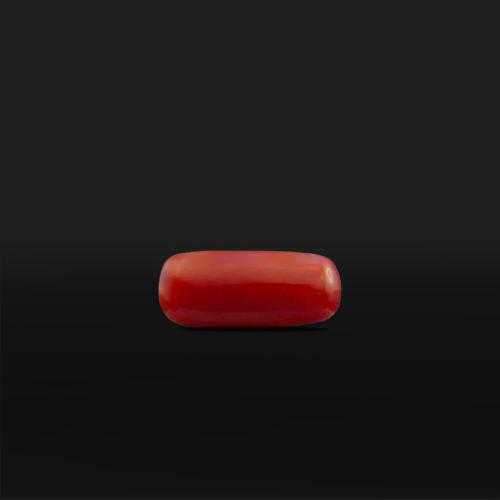
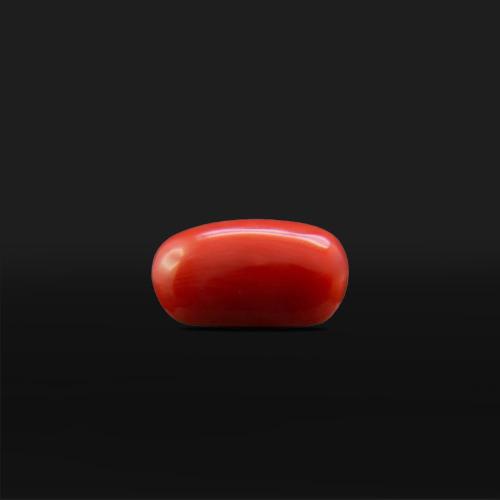
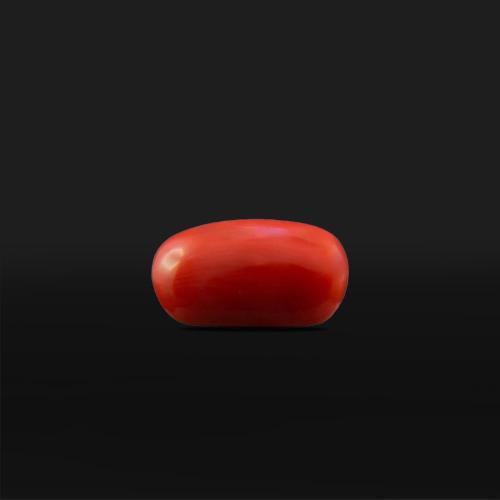
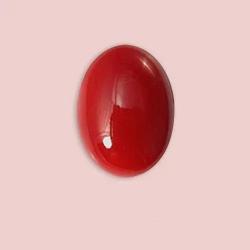
Red Coral, popularly known as Moonga Stone, is one of the most distinctive organic gemstones used in traditional Indian jewelry and Vedic astrology. Its vibrant red to reddish-orange color, smooth texture, and association with Mars (Mangal) have made it especially popular among gemstone buyers.
However, buying Red Coral can be confusing because stones sold in the market can differ considerably in natural color, treatment, origin, quality, size, and construction. A coral that looks bright red may not necessarily have its natural color.
This is particularly important because dyed or treated coral can look very similar to naturally colored coral while carrying a significantly different market value.
In this guide, we'll explain Red Coral prices, natural vs treated coral, the factors that determine value, how treatment affects price, certification, and what buyers should check before purchasing.
Important: Prices for Red Coral vary widely by quality, source, treatment, size, seller, and market conditions. Any price range should be treated as an indicative guide rather than a fixed market rate.
What Is Red Coral?
Red Coral is an organic gem material formed by marine organisms rather than through the same geological processes as minerals such as Ruby or Sapphire.
Fine red coral has historically been used for:
- Jewelry
- Beads
- Carvings
- Religious objects
- Traditional ornaments
- Astrological gemstones
The natural red-to-pink color range is particularly valued, while highly saturated red material can command a premium.
The supply of high-quality natural-color pink-to-red coral has become more limited, while dyed coral has become increasingly common in the market. (gia)
What Is Red Coral Called in Astrology?
In Vedic astrology, Red Coral is commonly known as Moonga and is traditionally associated with Mars (Mangal).
Mars is traditionally connected with:
- Courage
- Energy
- Confidence
- Determination
- Leadership
- Physical vitality
- Action
Astrologers may recommend Red Coral after examining an individual's birth chart.
These astrological associations are based on traditional beliefs and are not scientifically established.
Red Coral Price: What Should You Expect?
There is no single fixed price for Red Coral.
Two stones of the same weight can have dramatically different prices because of differences in:
- Natural vs treated color
- Color intensity
- Origin
- Surface quality
- Porosity
- Shape
- Size
- Polish
- Certification
- Overall appearance
For example, a commercially available treated coral may cost considerably less than a high-quality natural-color coral with reliable laboratory documentation.
Some current Indian market guides quote natural Red Coral in broad ranges from roughly ₹500 to ₹10,000+ per carat, depending on quality and claimed origin. These figures are seller-market estimates rather than an official industry price list, so buyers should compare the actual stone and certification rather than relying on a quoted per-carat number. (Shubh Gems)
Natural Red Coral vs Treated Red Coral
This is one of the most important distinctions for buyers.
| Feature | Natural-Color Red Coral | Treated/Dyed Coral |
|---|---|---|
| Color | Naturally occurring | Color enhanced or altered |
| Rarity | Relatively limited | More readily produced |
| Price | Usually higher for fine quality | Usually lower |
| Appearance | Natural color variation | Can appear unusually uniform |
| Treatment | No color treatment | May be bleached, dyed, coated, or impregnated |
| Certification | Highly recommended | Treatment should be disclosed |
| Value | Higher when quality is fine | Generally lower than comparable natural-color material |
GIA research has documented the use of bleaching and dyeing to turn pale or white coral into more desirable pink-to-red colors. (gia)
Why Is Natural Red Coral More Expensive?
Natural-color coral is limited, and high-quality material with attractive color and good surface characteristics can be difficult to obtain.
Environmental and legal considerations have also contributed to reduced availability of some high-quality natural-color coral. GIA has reported that the supply of high-quality natural-color pink-to-red coral has decreased while dyed coral has become more prevalent. (gia)
This combination of rarity, appearance, availability, and demand contributes to higher prices for desirable natural-color material.
Factors That Affect Red Coral Price
1. Natural Color
Color is one of the most important factors.
Desirable Red Coral may range from:
- Pinkish red
- Orange-red
- Bright red
- Deep red
- Rich reddish-orange
Strong, attractive natural coloration can increase value.
However, darker does not automatically mean better. The overall appearance, saturation, uniformity, and surface quality need to be considered together.
2. Surface Quality
A good-quality coral generally has an attractive, smooth surface with fewer distracting pits, cracks, or irregularities.
Fine surface quality can significantly influence its appearance and price.
Because coral is an organic material, some natural surface characteristics are normal.
3. Size
Larger pieces of high-quality natural coral can be more difficult to source.
As size increases, a good-quality natural specimen may therefore command a higher price per carat.
However, size should never be considered independently from color and quality.
4. Shape
Red Coral is commonly fashioned into:
- Oval cabochons
- Round beads
- Capsule shapes
- Triangular forms
- Smooth polished pieces
In the astrological jewelry market, particular shapes may be preferred by individual buyers or traditions.
The cutting process can also affect material yield, which may influence price.
5. Origin
Origin can influence market perception and price, particularly when the origin is supported by reliable documentation.
Red Coral has historically been associated with Mediterranean sources, while coral materials from other regions can also appear in the market.
However, origin should not be treated as a substitute for quality.
A well-documented stone should be evaluated based on its actual characteristics rather than simply a location name used in marketing.
Italian Red Coral
Mediterranean or Italian coral has a long history in jewelry and carving.
High-quality material can display attractive:
- Red color
- Smooth surface
- Fine texture
- Consistent appearance
Because of its historical reputation and availability considerations, fine Italian coral may command a premium.
However, a claim such as "Italian Coral" should ideally be supported by appropriate documentation when the stone is being sold at a premium.
Japanese Red Coral
Japanese coral is also highly regarded in parts of the gemstone and jewelry market.
Fine examples may display attractive red or reddish-pink colors and good surface quality.
As with other origins, not every stone from a particular country has the same quality.
Origin is only one part of the valuation process.
What Is Treated Red Coral?
"Treated" coral refers to coral that has undergone a process intended to alter or improve its appearance or physical characteristics.
Common treatments can include:
Bleaching
Bleaching can lighten the original color of coral.
Dyeing
Pale or white coral can be dyed to create stronger pink, orange, or red colors.
Polymer or Resin Impregnation
Some coral can be impregnated with polymer materials to improve its appearance, smoothness, or perceived durability.
GIA notes that bleaching may be followed by polymer impregnation, while dyed coral may also receive treatments intended to improve its appearance. (gia)
Why Is Dyed Coral So Common?
Natural high-quality red coral is relatively limited, while demand exists for attractive red material.
Dyed lower-color coral can therefore provide a less expensive way to create a stronger red appearance.
GIA's research found that pale-colored and white coral is commonly bleached and then dyed to achieve more desirable pink-to-red colors. (gia)
This does not mean every treated coral is fraudulent.
The key issue is disclosure.
A treated gemstone should be sold as treated rather than represented as untreated natural-color coral.
Does Treatment Make Red Coral Fake?
Not necessarily.
A treated coral can still be genuine coral material.
The important distinction is:
Natural coral material + treatment ≠ imitation
For example, a coral piece that has been dyed is still coral, but its color is not entirely natural.
An imitation made from plastic, resin, or another material is a different category altogether.
Therefore, buyers should distinguish between:
- Natural-color coral
- Treated coral
- Reconstructed/composite coral
- Imitation material
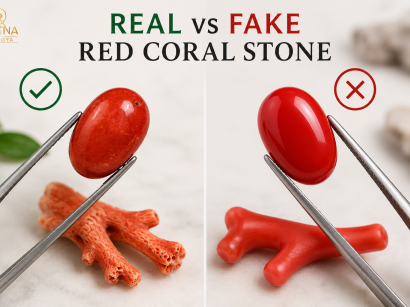
How to Identify Natural vs Dyed Red Coral
Visual inspection alone is not always reliable.
Some clues can include:
- Unusually intense or uniform color
- Color concentration around pores or surface features
- Unnatural-looking color distribution
- Differences between surface and internal coloration
GIA has documented cases where microscopic examination revealed concentrations of coloring material in pores and cavities. (gia)
However, these observations should not be treated as a definitive home test.
Professional laboratories can use microscopy and analytical techniques to determine whether the color is natural or treated. GIA notes that Raman analysis can conclusively establish natural color in studied pink-to-red coral samples. (gia)
Why a Gemstone Certificate Is Important
A certificate becomes particularly valuable when buying expensive Red Coral.
A professional gemological laboratory can examine the material and identify relevant characteristics and treatments.
Modern gemological laboratories may use:
- Microscopy
- Spectroscopic analysis
- Raman analysis
- Other advanced testing methods
GIA explains that gemstone laboratories examine stones for identity and treatments using microscopic and analytical techniques. (gia)
For a high-value purchase, a report can provide much greater confidence than a seller's verbal claim.
Can You Identify Red Coral at Home?
Basic observations can help you spot suspicious material, but they cannot reliably establish whether expensive coral has natural color.
Avoid relying on risky methods such as:
- Burning the stone
- Scratching it aggressively
- Applying chemicals
- Using acids
Such tests can damage the gemstone and may also produce misleading results.
For valuable coral, laboratory testing is the safer approach.
Red Coral for Astrology: Why Natural Color Matters
People buying Red Coral for astrological purposes often specifically seek natural, untreated material.
Traditional gemstone practices may place importance on the natural character and quality of the stone.
However, astrological claims about the effects of natural versus treated coral are matters of tradition rather than scientific evidence.
If the purpose of purchase is astrological, buyers should clearly ask the seller:
"Is this natural-color Red Coral, and does the certificate mention any treatment?"
That simple question can prevent considerable confusion.
Natural Red Coral vs Treated Coral: Price Comparison
A simplified comparison looks like this:
Budget Category
Treated or dyed coral
Usually more affordable and suitable for buyers primarily interested in appearance.
Mid-Range Category
Natural-color coral of commercial quality
Better suited to buyers looking for genuine natural color without necessarily purchasing top-grade material.
Premium Category
Fine natural-color coral
Strong color, attractive surface, good structure, desirable size, and reliable documentation can place a stone in a significantly higher price category.
Collector/Exceptional Category
Rare, high-quality natural coral with excellent color, surface quality, size, provenance, and documentation can command substantially higher prices.
There is no universal price-per-carat table that applies to every Red Coral because the market is highly quality-dependent.
Why Extremely Cheap Red Coral Can Be a Warning Sign
If a seller offers a large, perfectly smooth, intensely red coral at an unusually low price, don't automatically assume you've found a bargain.
It may be:
- Dyed coral
- Reconstructed coral
- Composite material
- Another type of coral
- An imitation
- Poor-quality natural material
This is why price should be evaluated together with certification and treatment disclosure.
How to Buy Red Coral Safely
Before purchasing, ask the seller these questions:
1. Is it natural coral?
Ask for the exact material identification.
2. Is the color natural?
Don't assume that "natural coral" means "natural color."
3. Has it been dyed or bleached?
Treatment disclosure is important.
4. Is it impregnated?
Ask whether resin or polymer has been used.
5. What is the origin?
If origin is being used to justify a premium, request supporting documentation.
6. Is there a laboratory report?
For expensive coral, certification is strongly recommended.
7. What is the return policy?
A reputable seller should provide transparent purchase and return terms.
Red Coral Care Tips
Red Coral is softer and more sensitive than many mineral gemstones.
To protect it:
Avoid Chemicals
Keep coral away from:
- Perfume
- Hairspray
- Household cleaners
- Strong detergents
- Acids
- Solvents
Avoid Hard Impacts
Coral can scratch or fracture more easily than Ruby or Sapphire.
Store Separately
Keep Red Coral away from harder gemstones to avoid scratches.
Clean Gently
Use a soft, slightly damp cloth and avoid aggressive cleaning methods.
If the coral is dyed or treated, additional care may be necessary because certain solvents can affect dyes. GIA specifically notes that dyes may be vulnerable to substances such as alcohol or acetone and can sometimes fade with prolonged UV exposure. (gia)
Common Red Coral Buying Mistakes
Mistake 1: Assuming Bright Red Means Natural
A very bright red color can be produced through dyeing.
Mistake 2: Buying Only by Carat Weight
A heavier stone isn't necessarily more valuable.
Mistake 3: Ignoring Treatment
Treatment can significantly affect value and care requirements.
Mistake 4: Trusting Origin Claims Without Documentation
A country name alone does not prove origin.
Mistake 5: Skipping Certification for Expensive Stones
The cost of a laboratory report can be small compared with the potential loss from purchasing misrepresented material.
Frequently Asked Questions
What is the price of natural Red Coral?
There is no fixed price. Indicative Indian market listings can range from hundreds to several thousand rupees per carat, with fine natural-color material potentially exceeding ₹10,000 per carat. Actual prices depend heavily on quality, origin, size, treatment, and documentation. (Shubh Gems)
Is natural Red Coral more expensive than treated coral?
Generally, fine natural-color coral commands a premium over comparable dyed or treated material because natural high-quality color is more limited.
Is dyed Red Coral fake?
Not necessarily. Dyed coral can be genuine coral material whose color has been artificially altered. It should simply be disclosed as treated.
How can I tell if Red Coral is dyed?
Some clues may be visible under magnification, but definitive identification often requires professional gemological testing. GIA describes microscopy, acetone testing in appropriate laboratory contexts, and Raman analysis among methods used to investigate coral color origin. (gia)
Is Italian Red Coral better than other coral?
Italian/Mediterranean coral has a strong historical reputation, but quality varies between individual stones. Origin alone does not guarantee superior quality.
Should I buy Red Coral without a certificate?
For a low-cost decorative purchase, certification may not always be necessary. For an expensive gemstone—especially one being sold as rare, natural-color, or premium-origin coral—a reputable laboratory report is strongly advisable.
Can treated Red Coral be worn?
Yes, treated coral can be worn as jewelry. However, buyers should know what treatment has been performed because it can affect durability, cleaning, and value.
Conclusion
Red Coral or Moonga Stone is a unique organic gem material with a long history in jewelry and traditional astrology. Its vibrant red color makes it highly desirable, but that same demand has also created a market where dyed and treated coral can closely resemble natural-color material.
The most important lesson for buyers is simple:
Don't judge Red Coral by color alone.
Before purchasing, consider:
- Natural or treated color
- Material identity
- Surface quality
- Color saturation
- Size
- Origin
- Treatment
- Certification
- Seller transparency
Fine natural-color coral can command a significant premium, while treated coral can offer a more affordable alternative for jewelry. Neither should be confused with an imitation, and treatment itself does not automatically make a coral piece fake.
If you are purchasing Red Coral for astrological purposes, make sure the stone's treatment status is clearly documented rather than relying solely on appearance or verbal assurances.
A carefully evaluated, properly documented Red Coral is not only a beautiful piece of jewelry—it is also a much more informed investment.
Share this post:
You Might Also Be Interested In
Discover more insightful articles related to this topic to deepen your gemstone knowledge.
19 May
Benefits Of Wearing Yellow Sapphire and Ruby Together
The planet Jupiter (Guru) is represented by Yellow Sapphire (Pukhraj), whereas the Sun is represented...
6 July
Hessonite Gemstone Benefits in Astrology: Complete Guide
Hessonite, popularly known as Gomed or Gomedhikam, is one of the most significant gemstones in...
3 May
Check out some coolest gemstone to pair up with any Attire
1. Amethyst GemstonesTo reevaluate is to relook and Amethyst is best for reevaluation. To enable...
11 March
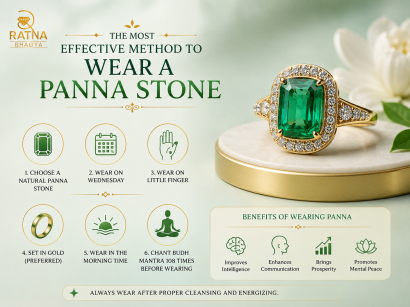
The most effective method to Wear a Panna Stone
The rich green-shaded exquisite emerald is an incredibly exceptional gemstone of the Navratna family. It...
13 July
Some Amazing Facts About July Birthstone
Rubies have long been cherished by royalty and aristocracy who might be afforded the exorbitant...
9 September
How to Choose the Right Gemstone According to Astrology
Choosing a gemstone according to astrology is not simply about picking a beautiful stone or...